©
ADDRESS
via di Campo marzio, 4
34123 Trieste, ITALY
tel. +39 2450325
info@erikaskabar.com

KEY PROJECT
LANDSCAPE AS WORKPLACE INFRASTRUCTURE
HOW CAN GREEN INFRASTRUCTURE IMPROVE ENVIRONMENTAL PERFORMANCE, COMFORT AND WELLBEING IN OFFICE ENVIRONMENTS?
VIA VITTOR PISANI 22
INTEGRATING GREEN INFRASTRUCTURE IN THE WORKPLACE
Location: Milano - Italy
Client: A.M. Holdings S.p.a.
Lead Architect: Tectoo Srl - Milano
Period: 2022-2018
Scope: Landscape General project, across Schematic Design, Developed Design and Construction Documentation
Design team: Tectoo Srl - Lead Architect; Molteni Srl - Project Management; Milan Ingegneria Srl - Structural Engineering; Ariatta Srl - MEP; B&B Srl - Cost management; Studio Bonnaure - Acustics Engineering; Tecservice Srl - Commisioning authority; Studio idrogeotecnico Ghezzi Srl - Ground Engineering; Gae Engineering - Fire Engineering; Telecert Srl - Health and safety; R2M Srl LEED
Project status: Completed
Certification: LEED Platinum
Context
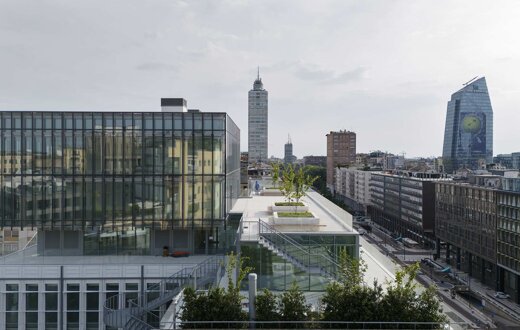
This project integrates green infrastructure within a contemporary workplace environment at Via Vittor Pisani 22 in Milano.
Landscape elements — including roofs, gardens, courtyards and terraces — are conceived as active components of the working environment, rather than as isolated decorative features.
Landscape is treated as functional infrastructure, interwoven with architectural and building systems to support environmental performance, comfort and wellbeing within the office context.
Challenge
To investigate how green infrastructure can improve environmental performance, comfort and wellbeing in an office environment by making landscape an integral part of both spatial organisation and environmental systems, indoors and outdoors.
Key issues included:
- integrating planted surfaces to enhance thermal behaviour and microclimate regulation
- using vegetation to improve acoustic and visual comfort
- linking green infrastructure to workspace use patterns
- supporting indoor environmental quality in line with LEED performance requirements.
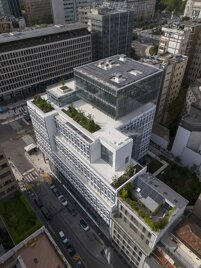
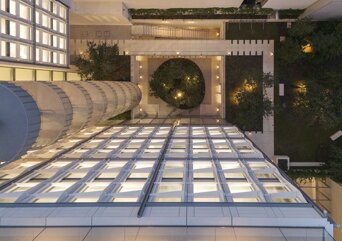
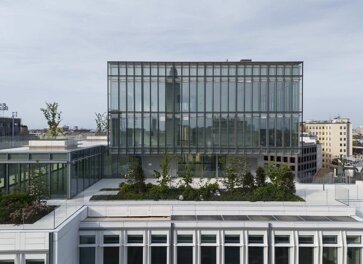
GREEN INFRASTRUCTURE FOR WORKPLACE PERFORMANCE.
Landscape strategy
Landscape was developed as environmental and spatial infrastructure contributing directly to building performance and workplace quality.
Key spatial and environmental devices included:
- Rooftop gardens and planted terraces, providing thermal insulation, solar control and microclimate regulation, contributing to reduced heat gain and lower energy demand
- Green courtyards and planted surfaces extending usable workspaces outdoors and reinforcing continuity between interior and exterior environments
- Indoor vegetation systems functioning as acoustic buffers and spatial filters, improving visual comfort and enabling flexible use of internal spaces
- A continuous environmental system in which greenery supports comfort and wellbeing throughout the workplace.
Role and responsibility
Landscape consultancy including:
- integration of green infrastructure within spatial planning
- coordination between landscape and architectural systems
- support to environmental performance strategies
- contribution to the LEED certification process through landscape-based measures.
Value for the project
The project demonstrates that green infrastructure can play a measurable role in improving environmental performance, comfort and wellbeing in office environments.
In particular, landscape integration contributed to:
- enhanced building performance through thermal regulation, solar control and microclimate improvement
- improved indoor environmental quality by moderating internal conditions and reducing heat island effects
- increased comfort and visual quality through vegetation acting as acoustic and spatial mediation
- a human-centred workplace environment, supporting wellbeing and contributing to the achievement of LEED Platinum certification.
Overall, the project illustrates how landscape, when integrated as infrastructure rather than ornament, can support environmental performance and everyday quality in contemporary workplace design.