©

ADDRESS
via di Campo marzio, 4
34123 Trieste, ITALY
tel. +39 2450325
info@erikaskabar.com
KEY PROJECT
GREEN INFRASTRUCTURE FOR URBAN REGENERATION
WHAT ROLE CAN GREEN INFRASTRUCTURE PLAY IN TRASFORMING AND MANAGING POST-INDUSTRIAL SITES?
SHARED FRAMEWORK
Developed on the former Falck steelworks site and structured by Renzo Piano’s General Plan, the MilanoSesto regeneration area (approx. 1.4 million sqm) addresses long-standing ecological fragmentation produced by decades of industrial use.
Here, green infrastructure operates as a structural territorial system, coordinating soil, water, vegetation, mobility, and open space to support regeneration, environmental performance, and long-term management.
Within this framework, the two projects address green infrastructure at complementary levels:
- the MilanoSesto District Plan, structuring one urban district through public spaces, gardens, and green roofs
- the Ex Falck Park System Resource Management Guidelines, defining a public park model and management strategy for the entire masterplan.
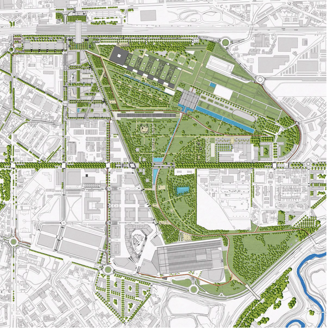
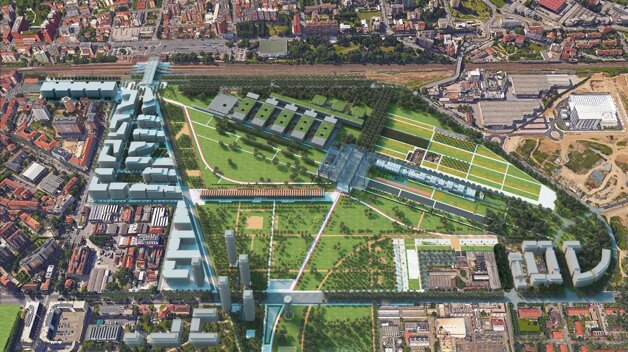
MILANOSESTO DISTRICT PLAN - UCP 1A,1E at SESTO SAN GIOVANNI
URBAN OPEN SPACE AND GREEN INFRASTRUCTURE FRAMEWORK
Location: Sesto San Giovanni, Milano - Italy
Client: Milanosesto - Milano
Period: 2019-2018
Scope: Landscape consultancy
Design team: Tectoo Srl - Lead Architect; Milan Ingegneria Srl - Structural Engineering, Cost management; United Consulting Srl - MEP; Montana Spa - Environmental and Acoustics consultancy ; Gae Engineering - Fire Engineering; TRM Engineering — Transport and Mobility consultancy.
Project status: Completed
Context
The MilanoSesto District Plan forms part of the General Plan for the former Acciaierie Falck steelworks, one of the largest post-industrial regeneration areas in Europe.
Extending over approximately 1.4 million sqm, the masterplan—designed by Renzo Piano Building Workshop—defines a new mixed-use district of approximately 65 hectares, embedded within a continuous green system.
At district scale, green infrastructure translates masterplan principles into a coherent system of urban open spaces, contributing directly to the territorial green infrastructure of MilanoSesto.
Challenge
The project required an urban open-space system capable of:
- supporting dense, mixed-use development
- mediating the relationship between the urban district and the adjacent park system
- integrating green infrastructure with mobility and built form
- responding to the constraints imposed by deep and extensive soil remediation.
Given the scale of remediation, early soil reconstruction and planting were essential to avoid prolonged phases of exposed ground during phased construction.
Landscape strategy
Gren infrastructure is articulated through a network of urban spaces—squares, widened streets, promenades, tree-lined avenues, gardens, and green roofs—working together as a multi-layered system for microclimate regulation, water management, and everyday urban use.
Special attention is given to edge conditions between the district and the park, ensuring continuity while maintaining distinct urban and landscape identities.
Planting is introduced in advance of building construction, allowing vegetation to establish early and deliver environmental performance from the outset.
Role and responsibility
Landsape consultancy, including:
- development of the urban open-space system;
- integration of gardens and green roofs;
- coordination with soil remediation and phasing;
- definition of district–park edge conditions;
- coordination with environmental and infrastructural consultants.
Value for the project
The project demonstrates how green infrastructure can structure urban districts, ensuring environmental performance, spatial continuity, and usability throughout the regeneration process.
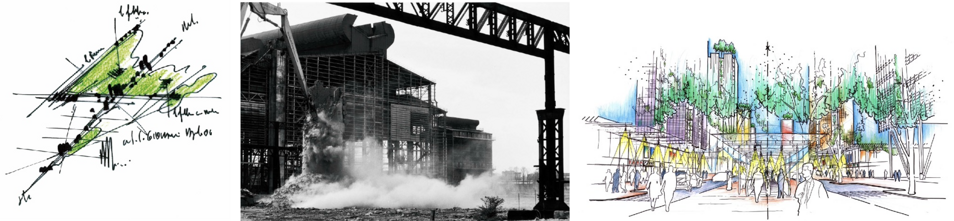

GREEN INFRASTRUCTURE AS TERRITORIAL SYSTEMS FOR POST-INDUSTRIAL LAND.


EX FALCK PARK SYSTEM - RESOURCE MANAGEMENT GUIDLINES
PUBLIC PARK AND GREEN INFRASTRUCTURE MANAGEMENT FRAMEWORK
Location: Sesto San Giovanni, Milano, Italy
Client: Milanosesto - Milano
Period: 2019-2018
Project services: Landscape consultancy
Design team: Tectoo Srl - Lead Architect; Milan Ingegneria Srl - Structural Engineering, Cost management
Work progress status: Completed
Context
Within the MilanoSesto framework, the Ex Falck Park System develops green infrastructure at park and masterplan scale. Covering approximately 310,000 sqm, it forms a continuous open-space system linking the Unione and Concordia districts to the City of Health and Research.
The park is defined by the presence of the former Falck steelworks, one of Europe’s largest industrial archaeology sites, whose structures shape scale, spatial sequences, and identity. Landscape, industrial remains, and open space operate as a single infrastructural system.
Challenge
The challenge was to define a public park model suitable for a very large urban area, avoiding maintenance-intensive landscapes and event-driven programmes.
Key issues included:
- long-term management of extensive green areas
- continuous public presence without reliance on stadiums, arenas, or commercial facilities
- integration of industrial archaeology as an active spatial framework
- balance between ecological processes, public use, and operational feasibility.
Landscape strategy
The park is structured through green infrastructure and industrial archaeology as complementary systems.
Given the scale of the area, the project adopts managed spontaneous green (verde spontaneo manutenuto) as a public park typology, ensuring accessibility and ecological performance while significantly reducing long-term management intensity.
The landscape is organised through a gradient of use and control, with more structured spaces near urban edges and more adaptive landscapes toward the interior. Public use is supported through distributed, low-intensity activities that vary across the day and seasons.
Industrial structures act as spatial frames and landmarks, while green infrastructure coordinates water management, soil processes, vegetation dynamics, and movement networks.
Role and responsibility
Landscape consultancy, including:
- definition of the public park typology
- development of resource management and maintenance guidelines
- integration of industrial archaeology within the landscape structure
- coordination of ecological, spatial, and operational criteria.
Value for the project
The project shows how large post-industrial parks can function as urban green infrastructure.
By integrating industrial archaeology as spatial infrastructure and adopting managed spontaneous green, the park reduces long-term management costs, supports continuous public use, strengthens site identity, and provides a flexible system capable of evolving over time.